What is the definition of Yoga?
For some, yoga is an activity to maintain or restore the body’s flexibility. For others, it is a workout, a connection with the divine, or the exact way of life. Anyone with a bit of knowledge about yoga might have their own definition of yoga.
As a yoga practitioner for years, I meet people from all backgrounds who hold different understandings of the term. I am not talking about types of yoga like Hatha, Ashtanga, Karma, or Bhakti. Today’s agenda is to examine the popular definitions of yoga originating from ancient philosophies, Indian scriptures, and modern Western practitioners.
Before looking at the first definition, we must understand that yoga originated in ancient India and developed within Hindu, Buddhist, and Jain traditions. Today, many cultural and secular contexts adopt its practices and aims.
Yoga teaches us this exact principle:
“to look past the boundaries set by the body and mind to understand who we truly are.”
While my name might be Tarun, my true identity as “the Self” transcends any name or label. I will return to this concept another time. For now, let’s quickly understand the meaning of the word ‘Yoga,’ which remains mostly consistent across all definitions.
What is meaning of Yoga?
Yoga comes from the Sanskrit word ‘Yuj,’ which literally means to yoke, join, or unite.
I remember my math teacher in school telling me to do the ‘yog’ of 2 and 3. In English translation, this means to sum up or add.
In classical Sanskrit contexts, ‘yoga’ can mean ‘joining’ or ‘addition’, similar to adding numbers. This acts as a literal usage rather than the philosophical meaning.
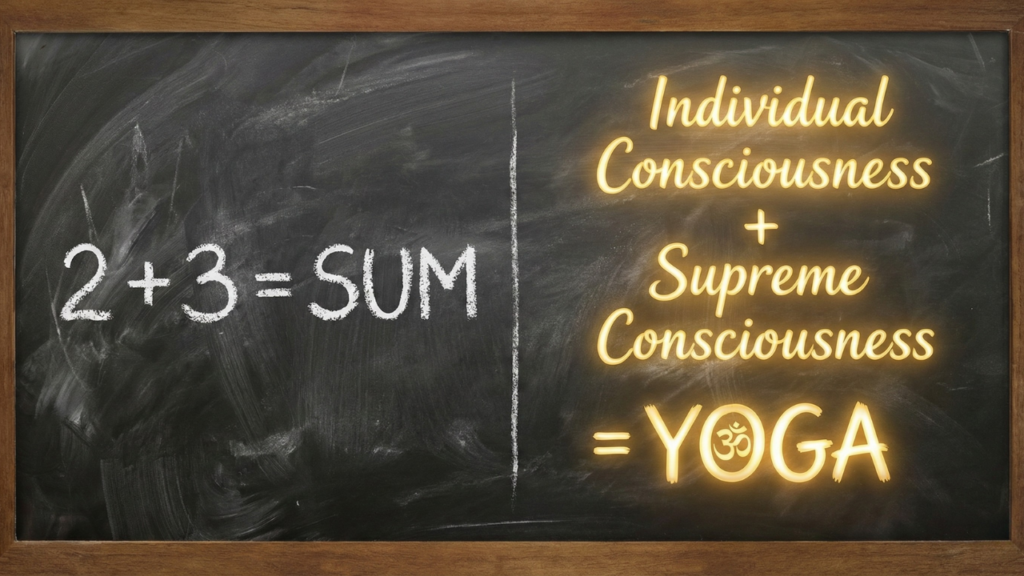
To create a sum, there must be at least two things. This article discusses what these two things are and the type of combination mentioned in different yoga definitions. Many of these definitions mention terms like consciousness and supreme consciousness, which you can understand as follows:
Individual consciousness acts as the soul. This includes you, me, and every life that exists. Some philosophies state that non-living objects have consciousness, but we will leave that for later.
Supreme consciousness acts as the great energy, power, or the divine.
I will share my knowledge on these in another article, as each term requires deep explanation.
Definition of Yoga according to the Kathopanishad
The Katha Upanishad characterizes yoga as a methodology for stabilizing the sensory organs. This prevents consciousness from bleeding outward into material existence, allowing the practitioner to focus entirely on the inner self. The Katha Upanishad emphasizes mastery over the senses (indriya-nigraha) and inner orientation as part of the path.
The text frames the Katha Upanishad as a dialogue between Nachiketa, a young truth seeker, and Yama, the god of death. Scholars date the Katha Upanishad roughly to the first half of the first millennium BCE (estimates vary). It discusses the subtle nature of reality and the process of spiritual liberation.
I put some major key points of this conversation in a YouTube video, which I recommend if you want a deeper understanding of the Katha Upanishad.
This stands as one of the earliest clear descriptions of yogic discipline. Here, the text strictly defines yoga as sensory restraint.
Over time, the definitions of yoga became increasingly structured. They evolved from general concepts of sensory restraint into specific, actionable methodologies.
Definition of Yoga according to the Maitri Upanishad
The Maitri Upanishad, another Indian scripture, states:
“a yoga practitioner should follow a six-limb path for ātma-darśanam”.
Here, ‘ātma’ means soul or individual consciousness, and ‘darśanam’ means to see or realize.
Following six specific mechanics creates an internal fire (tapas). These mechanics are restraint of breath (pranayama), withdrawal of the senses (pratyahara), meditation (dhyana), concentration (dharana), contemplative inquiry (tarka), and absorption (samadhi). This fire burns away ignorance and liberates the practitioner from the cycle of suffering and rebirth (samsara). The yoga practiced extensively today takes some of its basics from these six folds. We will come across them in the later section.
Definition of Yoga according to the Shvetashvatara Upanishad
Simultaneously, the Shvetashvatara Upanishad introduced somatic and physiological dimensions to the definition of yoga. It outlines the empirical, physical indicators of successful yoga practice:
‘Lightness of the body, freedom from disease, absence of desire for sense objects, glowing body, sweetness of speech, pleasant odor, and minimal urine and feces, these are the initial attainments resulting from the practice of yoga.’
I hope you can now see how texts no longer define yoga only by unseen psychological states. They accepted it as having deep, observable effects on human physiology and biometric health. We can see these observable effects as the result of yoga, but the practice still felt out of reach for everyday people. A farmer, a parent, or someone earning a living might struggle with it. Not everyone can live the life of a renunciate and follow the methodology mentioned above to achieve liberation.
Definition of Yoga According to Bhagavad Gita
The Bhagavad Gita is a dramatic dialogue on a battlefield between the warrior prince Arjuna, paralyzed by a moral crisis, and the divine avatar Krishna, acting as his charioteer and spiritual guide. Standing in the middle of the Mahabharata war, Arjuna faces many doubts. Krishna answers them by providing clarity and different ways to understand exactly what yoga is and how one can achieve liberation through it.
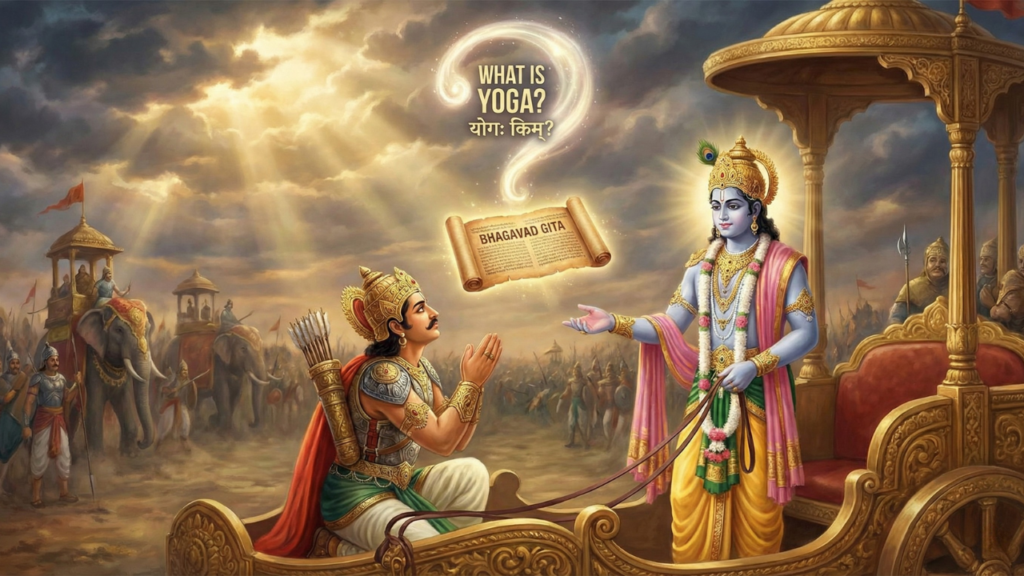
Krishna made sure the practice of yoga remained accessible to all tiers of society. He achieved this by integrating the strong psychological mechanics of yoga with daily social duty, morality, and warfare. Here, yoga happens when one engages with society. It does not happen by running away from it.
3 mentions of Yoga definitions in Bhagavad Gita
First, in verse 2.48, Krishna says ‘Samatvam yoga uchyate,’ which translates to ‘Equanimity of mind in success and failure is called Yoga.’ Yoga here represents inner mental stability. The practitioner keeps performing their actions in the material space, yet stays unaffected by profit or loss, joy or sorrow.
Again, in verse 2.50, Krishna says ‘Yogah karmasu kaushalam,’ translating to ‘Yoga is skill in action.’ I will make this easier for you. Yoga is the beautiful art of performing one’s social and moral duties, called ‘dharma’ in Sanskrit, in the best possible way. How is this different from what billions of people do every single day? It differs because the yogic way asks you to perform duties without craving or thinking about the fruits of your actions. This creates and maintains inward freedom.
Finally, in verse 6.23 (the verse may vary according to the scholarly edition), Krishna says ‘Duhkha-samyoga-viyogam,’ meaning ‘Yoga is the disconnection from union with suffering.’ Humans suffer either when we cannot possess something like an object, a feeling, a person, or a position, or when we receive something we do not want, like pain or stress. Both of these sufferings arise from the physical body and its experiences, to which we falsely identify ourselves. Through yoga, we stop this identification. We get to know the true nature of ‘the self,’ which acts as an unchanging and peaceful witness.
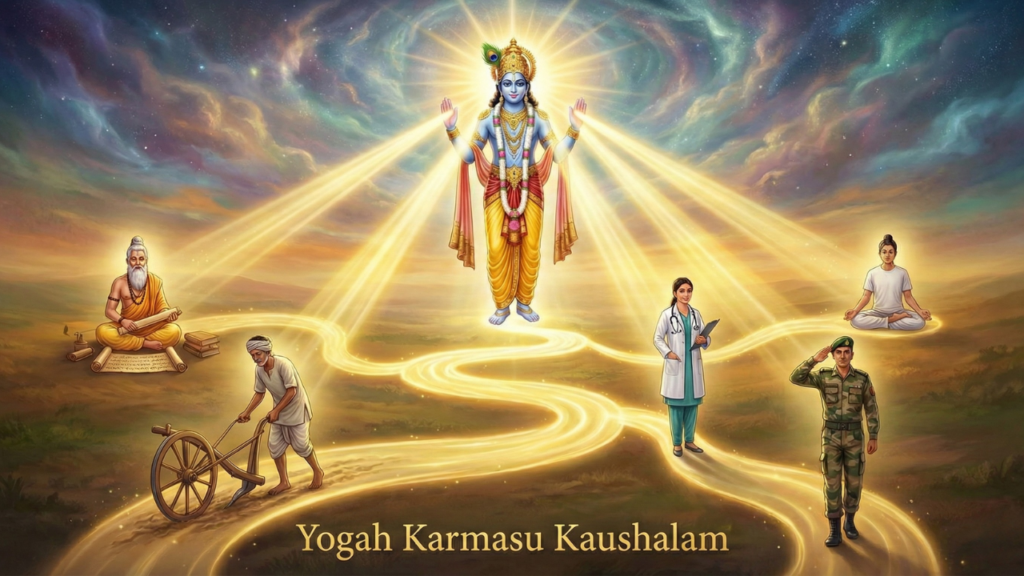
Why Bhagavad Gita is for everyone?
In the Gita, Lord Krishna made sure anyone could practice the discipline of yoga. It does not matter if you are a scholar, a devotee, a regular citizen, employed, unemployed, a student, a teacher, a farmer, or a consumer. You can achieve the union of individual consciousness and supreme consciousness. This union is liberation. To make sure everyone could achieve this, Krishna taught an array of paths leading to the same goal. He left the choice of path to the practitioner based on their interests. These spiritual approaches are Jnana Yoga, Karma Yoga, Bhakti Yoga, and Raja/Dhyana Yoga. I would love to share my knowledge on these in another article.
Definition of Yoga according to Patanjali Yoga Sutra
Between the 2nd century BCE and the 4th century CE (scholars differ on exact dates), Maharishi Patanjali compiled a foundational text for classical yoga philosophy. People know this text as the ‘Patanjali Yoga Sutras.’ According to Patanjali, the definition of yoga is ‘Yogaś-citta-vṛtti-nirodhaḥ.’ This means ‘Yoga is the cessation of mental modifications.’
According to Patanjali, thoughts, memories, sensory inputs, and emotional reactions constantly disturb our mind. This includes our intellect, ego, and sensory mind. Yoga is the practice to inhibit, still, and ultimately cease these psychological modifications. When a practitioner completely silences this mental noise, they achieve a state of objectless concentration and absolute stillness. The true observer, pure consciousness, or the soul finally rests in its original, self-luminous nature. This nature is completely free of cognitive distortion and false identification.
Raja Yoga and Ashtanga Yoga are names for the eight-stepped path created by Maharishi Patanjali to achieve the self-luminous nature we just discussed. In many modern sources, people call Patanjali’s Ashtanga (eight-limbed) yoga Raja Yoga. Historically, the terms have overlapping but not identical usage.
8 limbs of Yoga
Some of these eight limbs come from the six-limb path mentioned earlier in the Maitri Upanishad. These eight limbs are:
- Yama (Ethical restraints)
- Niyama (Personal observances)
- Asana (Physical postures)
- Pranayama (Breath control)
- Pratyahara (Sensory withdrawal)
- Dharana (Focused concentration)
- Dhyana (Unbroken meditation)
- Samadhi (Complete meditative absorption)
I won’t explain these eight limbs in depth today. I will leave that for another article. If you are interested in reading Patanjali Yoga Sutras, my recommendation is the one with translation and commentary by Swami Satchidananda Saraswati.
As Indian yoga systems developed, Jain and Buddhist mechanisms evolved in parallel.
Yoga According to Buddha and Buddhism
Gautama Buddha founded Buddhism through his teachings after enlightenment. Right from the beginning, Buddhism relied on meditative yoga to address its central philosophical premise: the existence of suffering and the emancipation from it.
Early Buddhist yoga structured itself around a threefold training method: morality (sila), concentration (samadhi), and wisdom (panna). In later times, texts defined yoga as a rigorous, interior analytical discipline focused exclusively on cognition, perception, and the nature of consciousness. Certain Buddhist schools (notably Yogācāra) emphasize mind-only analyses. Other Buddhist traditions focus on dependent origination, anattā (non-self), and different meditation frameworks. Yoga became the practice of observing the mind constructing reality and subsequently dismantling those constructions to achieve enlightenment.
Yoga According to Jain Philosophy
For those unfamiliar, Jainism is an ancient Indian religion that developed alongside Hinduism and Buddhism. They share cultural and philosophical exchanges, but they remain distinct traditions. Jain followers believe in reincarnation and the liberation of the soul.
In early Jainism, texts viewed yoga as the total sum of all activities of the mind, speech, and body. Jainism assumes that all physical and mental activity attracts physical karmic particles. These particles bind the soul and perpetuate the cycle of rebirth. The ultimate goal of spiritual practice was the complete cessation of yoga to achieve a static state of total stillness and emancipation known as ayoga. Later, a revised definition described yoga as the perfect union and integration of right belief, right knowledge, and right conduct. It serves as the true path to liberation.
Yoga according to Hatha Yoga and Tantra
With the rise of Tantra and Hatha Yoga during the medieval era, the definition of yoga transformed. Previously, texts suggested overcoming everything related to the physical body. With this transformation, texts describe the physical body as a sacred workshop. It becomes the best tool for achieving spiritual liberation, profound energetic power, longevity, and mastery over bodily processes.
Hatha texts present the body as a workshop for spiritual transformation, claiming that certain practices lead to health, longevity, and spiritual realizations. The Gheranda Saṁhitā presents yoga as a step-by-step discipline aiming at purification, bodily strength, and spiritual liberation. Hatha Yoga presents yoga as a seven-fold (saptanga) path: purification, posture, mudra, sense withdrawal, breath control, meditation, and absorption. Hatha Yoga practices are intense but consistently yield results. We will discuss Hatha Yoga further in a separate article.
Definition of Modern Yoga
A new movement called ‘modern yoga’ emerged in the late 19th and early 20th centuries. It combines ancient Indian philosophy with Western ideals of physical fitness, factual science, psychology, and wellness.
Definition of Yoga by different authors
In 1893, Swami Vivekananda addressed the World’s Parliament of Religions in Chicago. Vivekananda presented yoga in an internationally accessible way. He defined yoga as:
“a rational, scientific, and empirical method for understanding the self and realizing true divine potential”.
In the 20th century, T. Krishnamacharya synthesized traditional yoga philosophy with dynamic physical movement (vinyasa). Often called the father of modern postural yoga, he defined yoga as:
“an integrated practice of physical health, intense breath control, and devotion”.
Krishnamacharya and his students adapted asana practice, leading to modern postural forms.
Later, B.K.S. Iyengar defined yoga as
“a holistic mirror reflecting the nature of the soul through the alignment of the physical body”.
He emphasized alignment and therapeutics.
What is Yoga in 21st century?
In the 21st century, the definition of yoga continues to expand rapidly. In many modern contexts, yoga has secularized and reframed itself for wellness. Other streams continue to engage explicitly with Hindu cosmology and devotional practices.
Today, society often defines yoga as a commodity or a product. Studios sell it on the corners of every major city and town. Advertisements promote yoga extensively for increased physical beauty, muscular flexibility, and stress reduction.
However, some practitioners still work to define yoga and make its true form available to everyone. I believe the ultimate aim of human birth is liberation. A person can efficiently achieve this through the discipline of yoga. This does not mean we oppose modern practices. We simply ask that the real essence and goal of yoga remain intact. Practitioners should enjoy the health benefits as a byproduct, a wonderful bonus. Thank you for reading!