How Meera Bai died?
The question that transcends history
Namaste!
You are here because you are searching for the answer to a question that has baffled historians, enchanted poets, and guided spiritual seekers for over five centuries. You want to know how Meera Bai died.
In our modern world, we are obsessed with facts. We want dates, we want medical reports, we want post-mortem analyses. When a famous figure passes away, we expect a clear cause of death; heart failure, accident, old age. But when we speak of Meera Bai, the lioness of Rajasthan, India and the queen of Bhakti (devotion), one of the greatest devotee of Shri Krishna, these ordinary terms dissolve like mist in the morning sun. To ask how exactly Meera Bai died is to ask how a river dies when it enters the ocean.
Does it die? Or does it become infinite?
As a modern writer deeply rooted in the soil of India’s spiritual heritage, I am not here to give you a dry history lecture. I am here to take you on a journey, into the heart of this mystery. We will look at the historical records from 1547, yes. But we will also look through the “third eye” of the Upanishads, the Bhagavad Gita, and the Shrimad Bhagavatam. We will talk about the science of vibration, the psychology of surrender, and the meaning of True Love.
The Making of a Mystic: Why Death Could Not Touch Meera bai?
To easily understand the end of Meera’s life story, we must understand the fire that burned at its beginning. You cannot understand the explosion of a star without understanding the nuclear forces that held it together. Similarly, the event of how Meera Bai died was simply the final crescendo of a song that had been playing for fifty years.
Want to watch instead? Check out my video on Meera Bai’s life below.
The Seed of Devotion (Bhakti Beej)
Meera Bai was born around 1498 AD in the Kudki district of Rajasthan, India. She was a princess of the Rathore clan, the daughter of Ratan Singh and the granddaughter of the mighty Rao Dudaji of Merta. In those days, Rajasthan was a land of blood and steel, where warriors lived by the sword and died by the sword. But in the midst of this martial culture, a flower of pure devotion bloomed.
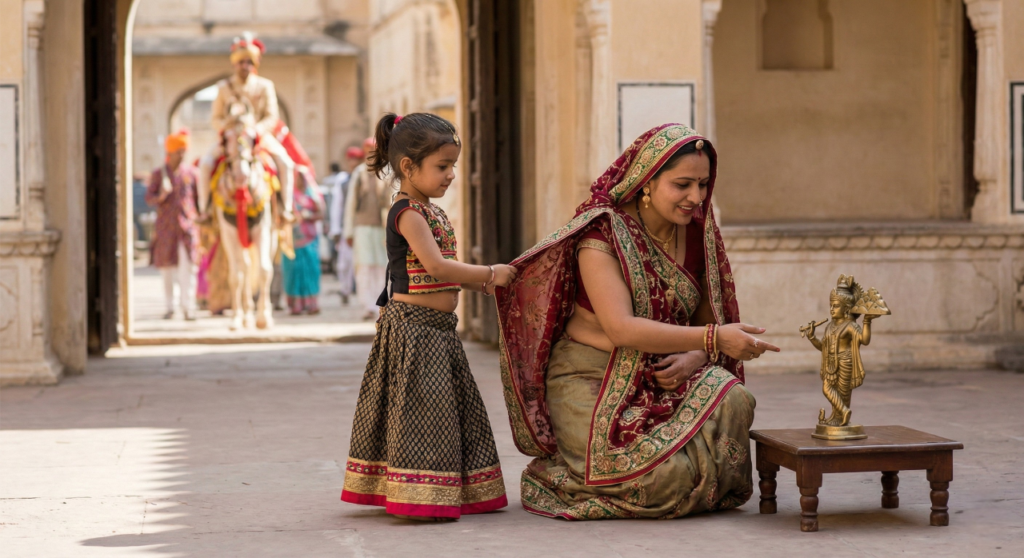
The legend, which is the heartbeat of her story, tells us that when Meera was just a child of four or five, she saw a marriage procession passing by her palace. The groom was dressed in finery, riding a horse. Innocently, Meera tugged at her mother’s sari and asked, “Mother, who is my husband?”
Her mother, Veer Kanwar, looked at the child, then looked at the small idol of Giridhar Gopal (Lord Krishna holding the mountain) that Meera played with. With a smile that would change history, she said, “He is your husband.”.
For the mother, it was a playful distraction. For Meera, it was a vow. From that moment, her psychological and spiritual biology changed. She did not grow up as a Rajasthani princess waiting for a prince; she grew up as a soul waiting for the Supreme Soul. This is vital to understand how Meera Bai died; she never considered herself a mortal body to begin with. She was, in her mind, already married to the Eternal.
The Clash of Dharmas
In 1516, Meera was married to Bhoj Raj, the crown prince of Mewar and the eldest son of the legendary Rana Sanga. This was a political alliance between two powerful Rajput clans, the Rathores and the Sisodias. But for Meera, it was a spiritual crisis.
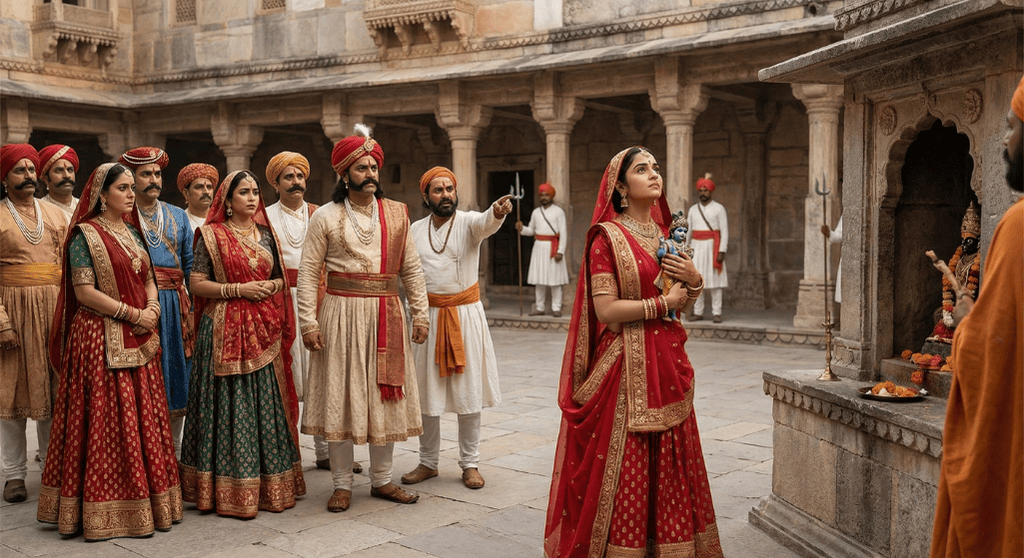
When she arrived at Chittorgarh Fort, she refused to bow her head to the family deity, Goddess Tulja Bhavani (an aspect of Durga). She said, “My head is already bowed to Giridhar Gopal. I cannot bow to another.” To the royal family, this was treason. To the modern yogi, this is one-pointed focus.
Her husband, Bhoj Raj, was surprisingly tolerant, but he died young, likely from battle wounds around 1521. This tragedy left Meera a widow at a very young age. In 16th century India, the life of a widow was kind of a living death. She was expected to strip herself of jewelry, live in a dark room, and perhaps even commit Sati (burning on the pyre).
Meera refused. She declared, “My husband, Giridhar Gopal, does not die. He is Immortal. So I am not a widow.” She put on her dancing anklets, picked up her Ektara (instrument), and began to dance in the public temples with sadhus and saints.
The Prequel to Meera Bai’s Death: The Poison and the Snake
This rebellion led to the attempts on her life that directly relate to our investigation of how Meera Bai died. The new King, Vikram Singh, felt that Meera was destroying the family honor. He decided she must die.
- The Cup of Poison: The King sent a cup of deadly poison, claiming it was Charanamrit (holy water). Meera knew it was poison because some of her well-wishers already informed Meera Bai. She offered it to her idol of Krishna, praying, “If you are real, you drink this.”
She then drank it.
- The Miracle: The poison turned into nectar. She did not die. She glowed with health.
- The Snake in the Basket: The King sent a basket of flowers with a deadly cobra hidden inside. When Meera opened it to offer flowers to Krishna, the cobra transformed into a Shaligram stone (a sacred symbol of Vishnu) or a garland of flowers.
Yogic Insight: Why do we recount these stories in a text about how Meera Bai died?
Because they establish a scientific/spiritual precedent. In the Yoga Sutras of Patanjali, it is stated that a Yogi who has mastered the element of water and the digestive fire (Samana Vayu) cannot be harmed by toxins. Meera’s devotion had raised her vibrational frequency so high that her biological system could transmute poison. If a lethal chemical dose could not kill her body, it stands to reason that “natural causes” were also subordinate to her will. She had already stepped out of the cycle of ordinary mortality.
The Final Pilgrimage of Meera bai: Why Dwarka?
Unable to live in the toxic environment of Chittorgarh, Meera Bai eventually left. She became a wandering renunciate. She traveled to Vrindavan, the playground of Krishna’s childhood, where she debated with the theologian Jiva Goswami, teaching him that in Vrindavan, the only male is Krishna and everyone else is female (prakriti).
About Prakriti and Purusha, I will share my knowledge when we talk about Sankhya Philosophy.
But for her final act, she chose Dwarka.
The Geography of the Soul
Dwarka, located on the western tip of Gujarat, is one of the Char Dham (four holy abodes).
Why did Meera Bai choose Dwarka and not Vrindavan for her death?
- Vrindavan is the land of Madhurya (sweet romance).
- Dwarka is the land of Aishwarya (majesty and power). It is the place where the river Gomti meets the infinite sea. Symbolically, Meera was the river Gomti. She had flowed through the mountains of Rajasthan and the plains of Braj(Vrindavan), and now she stood at the edge of the ocean, ready to merge.
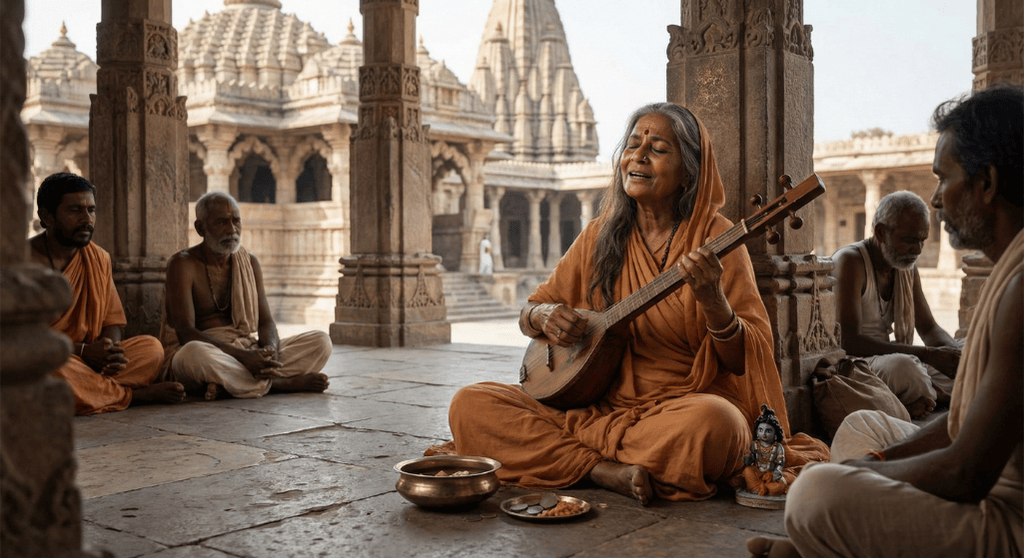
By 1547, Meera Bai was living constantly in the Dwarkadhish Temple (also known as the Jagat Mandir). She was around 49 or 50 years old. She was no longer the princess of Mewar; she was a beggar at the Lord’s door, subsisting on alms and the bliss of her devotional songs.
The crisis that triggered the end of Meera Bai
To answer how Meera Bai died, we must look at the political situation in Mewar. While Meera was in ecstasy in Dwarka, Chittorgarh was burning. Following her departure, the kingdom suffered a series of misfortunes. Defeats in battles, internal strife, and perhaps drought plagued the land. In the Indian collective consciousness, the mistreatment of a great devotee brings bad luck to the state. The people believed the land was cursed because they had driven out Meera Bai.
The King(likely Udai Singh II by this time, or the regency council) realized the mistake. They needed Meera back. Not as a queen, but as a spiritual talisman to save the kingdom.
The Brahmin Delegation
The King dispatched a group of high-ranking Rajpurohits (Royal Brahmins) to Dwarka.
Their orders were strict: “Do not return without Meera Bai.“
This delegation traveled hundreds of miles to the coast of Gujarat. When they found Meera in the temple, they were shocked. The woman who once wore silk and diamonds was now in simple saffron robes, glowing with a light that was blinding.
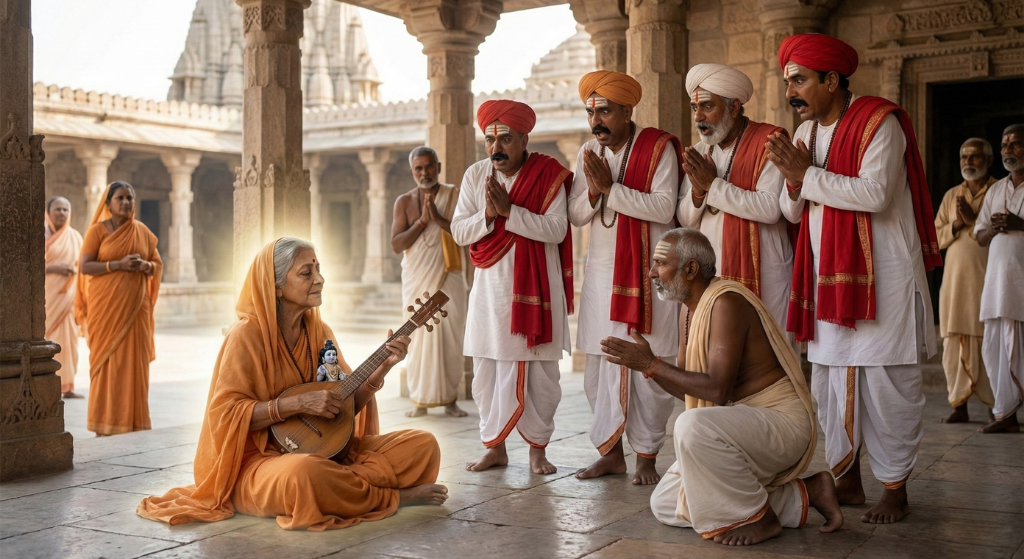
They pleaded with her: “O Mother, return to Chittor. The kingdom is suffering. The King repents. We need your grace.”
Meera smiled but refused. She sang, “I have abandoned the royal path. I have no home but this temple. The King and I have nothing in common anymore.”
The event of Meera Bai’s disappearance
Now we arrive at the exact moment that answers how Meera Bai died. The Brahmins, facing failure and fearing the King’s wrath, decided to use the ultimate weapon of moral coercion: The Dharna (Fasting unto Death).
They declared, “If you do not come with us, we will sit right here at the door of the temple and fast until we die. You, Meera, will be responsible for Brahma-hatya (the sin of killing a Brahmin).”
For a devout Hindu, Brahma-hatya is a catastrophic sin. Meera was trapped.
- Option A: Return to Chittor, back to the worldly life she had vomited out, and betray her soul.
- Option B: Let the Brahmins die and carry the heavy karmic burden of their death.
In this impossible situation, Meera turned to the only solution she knew: Krishna.
She told the Brahmins, “Wait. Let me go into the sanctum sanctorum one last time to take leave of my Lord. I will ask Him. If He releases me, I will come with you.”
What happened to Meera Bai inside Krishna’s temple?
Meera entered the inner chamber of the Dwarkadhish temple. The heavy wooden doors, adorned with silver and gold, swung shut. The Brahmins waited outside, confident that they had won. They heard the faint strumming of her musical instrument. They heard her voice rising in a final song.
The song she is believed to have sung at this moment is the famous pada: “Hari Tum Haro Jan Ki Pir” (Oh Hari, You take away the pain of your devotees). In this song, she lists the precedents:
- “You saved Draupadi from shame when she was being disrobed.”
- “You saved Prahlad from the demon Hiranyakashipu.”
- “You saved the elephant Gajendra from the crocodile.”
- “Now, save Meera. My pain is this separation. My pain is this world that wants to pull me back.”
The mystery of the Meera Bai’s Sari
The singing reached a crescendo and then… Silence.
Absolute, heavy silence.
The Brahmins waited. Five minutes. Ten minutes. No sound. No movement. Panic set in. They pushed open the heavy doors. The room was empty. There was no secret exit. The walls were solid stone. Meera Bai was nowhere to be seen. But there was one piece of evidence. Her Sari. The upper cloth of Meera Bai was found draped around the idol of Lord Krishna.
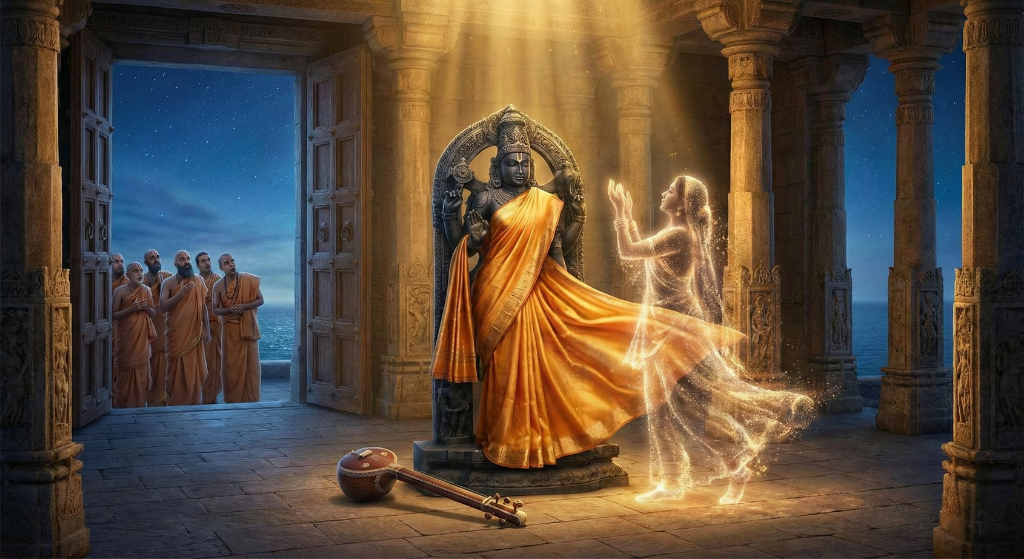
The conclusion drawn by the witnesses, and held by faith for 500 years, is that the idol of Krishna opened up, literally physically split or became liquid light and absorbed Meera Bai into Himself. She did not fall down dead; she walked into God.
This is the direct answer to how Meera Bai died: She merged.
Meera Bai’s death or merging with the God.
Is This Possible?
As a modern reader, you might say, “This is a beautiful story, but is it physically possible?”
Let us analyze the end of Meera Bai’s life through the lens of Yogic Science and Quantum Physics.
The Science of Resonance
In modern physics, we know that all matter is vibration. A stone wall is vibrating at a slow frequency; light is vibrating at a fast frequency.
- Nada Yoga: The Yoga of Sound. Meera was a master of sound. Her Bhajans were not just songs; they were Mantras.
- Resonance: When an opera singer hits a high C, a crystal glass shatters. Why? Because the frequency of the sound matches the natural frequency of the glass, causing the structure to lose its integrity.
Meera’s longing (Viraha) was of such high intensity that she raised the vibrational frequency of her physical body. At that final moment of total surrender, her frequency matched the spiritual frequency of the Deity (the Archa-vigraha).
When the frequencies matched, the barrier of physical matter collapsed. This is what we call Sayujya (Union). She didn’t “disappear” by magic; she transitioned from a particle state to a wave state. She became light.
Comparative Cases of Meera Bai
Meera is not the only one.
- Andal (Tamil Nadu): The mystic poetess who married Lord Ranganatha. She is recorded to have walked into the sanctum at Srirangam and merged into the idol.
- Chaitanya Mahaprabhu (Odisha): The golden avatar of love. He disappeared inside the Tota Gopinath temple in Puri, reportedly merging into the deity. These patterns suggest a specific “exit protocol” for high-level Bhakti Yogis.
Scriptural Evidence: What Do The Texts Say?
A. The Mundaka Upanishad (The River Analogy)
The most precise description of how Meera Bai died is found in the Mundaka Upanishad, Verse 3.2.8:
Yatha nadyah syandamanah samudre Astam gacchanti nama-rupe vihaya Tatha vidvan nama-rupad vimuktah Parat-param purusham upaiti divyam
Translation: “As flowing rivers disappear into the ocean, losing their separate name and form, so also the knower of Truth, freed from name and form, attains the Supreme Divine Being.”
- Meera = The River.
- Krishna = The Ocean.
- Death = The meeting point.
When the river meets the ocean, you cannot say the river “died.” But you also cannot find the river anymore. It has become the ocean. This is the state of Sayujya Mukti.
B. The Bhagavad Gita (The Yoga of the Last Thought)
In Chapter 8, Verse 6, Lord Krishna explains the mechanics of death:
Yam yam vapi smaran bhavam tyajaty ante kalevaram Tam tam evaiti kaunteya sada tad-bhava-bhavitah 14
Translation: “Whatever state of being one remembers when he quits his body, O son of Kunti, that state he will attain without fail.”
Krishna guarantees that the mental state at the moment of death determines the next destination. Meera was not thinking of the Brahmins, or the King, or her pain. She was thinking only of Krishna. She was singing to Him. Therefore, by the law of the Gita, she had to go to Him. It was unavoidable.
C. The Shrimad Bhagavatam (The Nature of Gopi-Prema)
The Shrimad Bhagavatam (Canto 10, Chapter 29-33) details the Rasa Lila, where the Gopis danced with Krishna.
- Snippet discusses Sayujya Mukti. It notes that usually, Vaishnavas do not want to merge; they want to serve (Seva). They prefer to keep their individuality.
- However, Meera’s case is unique. Her love was so intense that it burned away the “I”. She didn’t want to serve from a distance; she wanted to be the Lord’s own self. This is the Mahabhava state, where the lover and beloved become indistinguishable.
The meaning of “True Love“
The story of how Meera Bai died is not a tragedy; it is a love story. But it redefines what love is.
In our modern relationships, love is a transaction. “I love you if you love me.” “I love you if you provide for me.”
Meera’s love was Unconditional Surrender.
- Love is Fearless: Meera stood against an entire empire. She faced poison and snakes. True love destroys the fear of death.
- Love is Renunciation: She didn’t renounce the world because she hated it; she dropped it because her hands were full of Krishna. You cannot hold diamonds if you are holding the sun.
- Love is Identity Shift: She stopped being “Meera” and became “Krishna’s”.
When we ask how Meera Bai died, we are really asking: “How far can love go?” Meera answers: “It can go all the way to total dissolution.”
Alternative Perspectives of Meera Bai’s death
In the interest of being exhaustive, we must acknowledge the historians who ask how Meera Bai died without the mystical lens.
- Assassination Theory: Some scholars suggest that the Brahmins or spies killed her in the temple and disposed of the body to prevent a rebellion. The “miracle” story was invented to cover up a political murder.
- The Escape Theory: Others suggest she slipped out of a side door in disguise to escape the pressure, living the rest of her life as an anonymous beggar.
Yogic Rebuttal: While these theories are rational, they fail to explain the Shakti (power) of her legacy. A murdered woman inspires pity; a merged saint inspires transformation. The fact that her songs (Bhajans) are still sung 500 years later with such power suggests that the source of those songs was indeed divine. The “Miracle of the Sari” is the version that has survived because it resonates with the truth of her life.
Conclusion: The Keyword is “Forever”
So, how Meera Bai died?
- Historically: She disappeared in 1547 in the Dwarka Temple.
- Spiritually: She attained Sayujya Mukti (Union).
- Truly: She never died.
Meera Bai is more alive today than the King who tried to kill her. She lives in every temple bell that rings and in the throat of every singer who cries out “Giridhar Gopal”.
Meera Bai teaches us that we are not these bodies. We are eternal sparks of the Divine Fire. And if we can kindle that fire of love in our own hearts, even for a moment, we too can overcome death.
If you are walking through the dark night of the soul, remember Meera. Remember that the door to the Divine is always open. You just have to be willing to walk through it, leaving everything else behind.
Om Shanti Shanti Shanti.