Often, people ask me what is karma yoga. In the Bhagavad Gita, a holy Hindu scripture, Lord Krishna explains different paths. Specifically, he gives the disciplines of knowledge (Jnana), action (Karma), devotion (Bhakti), and meditation (Dhyana). In this article, I focus on the discipline of action. As my main sources, the karma yoga book “The Secret of Karmayoga” by Jayadayal Goyandka and the “Srimad Bhagavadgita” by Swami Ramsukhdas are used. When I mention God here, it does not mean just one form. It can be the divine in any form you believe in. Alternatively, you can think about the supreme consciousness or humanity, because humanity is also a manifestation of the divine.
Table of Contents
ToggleThe Karma Yoga meaning and Definition
First, we must understand the word karma. Simply translated, it means action or the result of an action. Therefore, we understand every action you perform as karma. But why do people often see karma as a force governing justice? This idea comes from the belief that no action ever gets lost. Every action leads to an outcome, often called the fruit of karma. This fruit can be positive, negative, or mixed. Importantly, it depends largely on the intention behind the action.
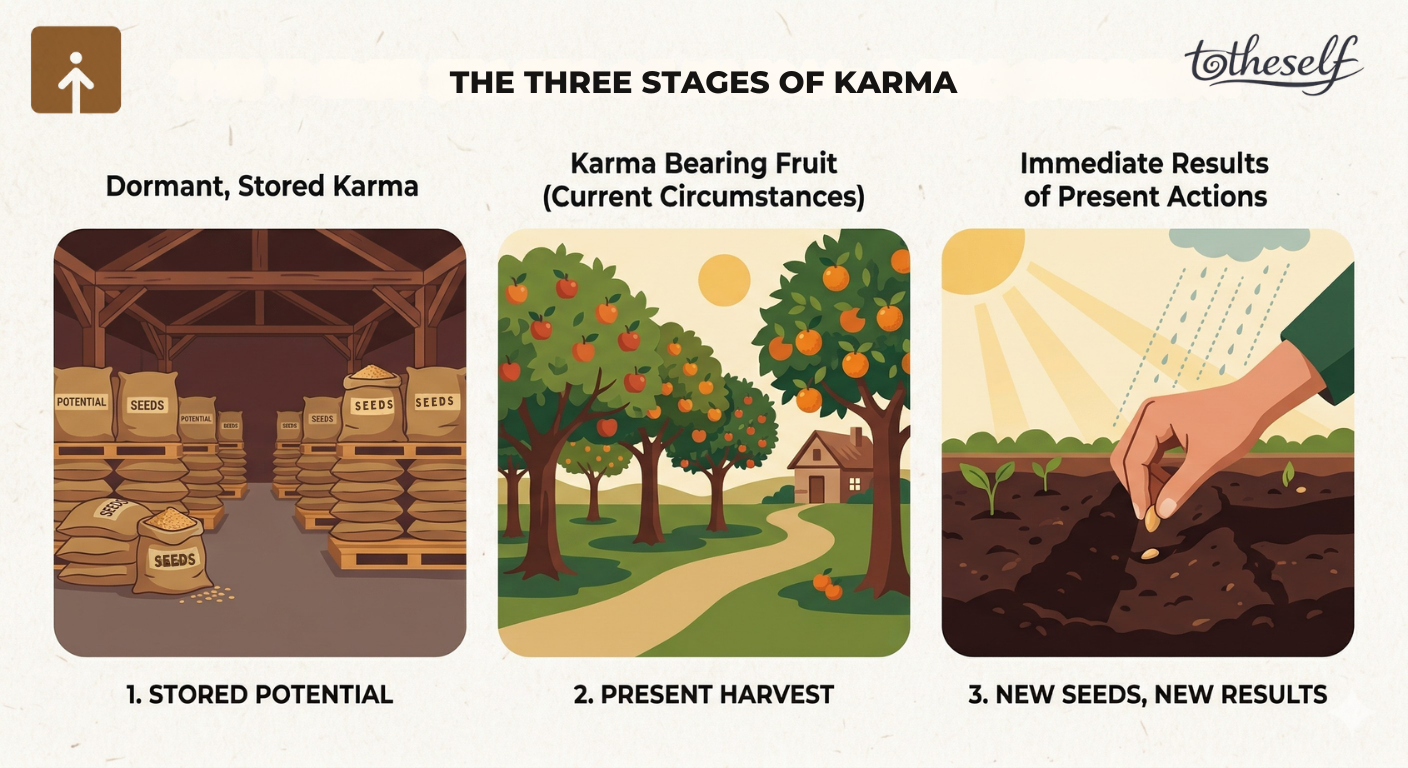
In karma yoga in hinduism, texts describe karma in different layers. Stored karma exists that has not yet ripened. Additionally, some karma bears fruit in this lifetime, shaping current circumstances. Finally, immediate results of present actions exist. Past results influence our current actions, creating a continuous cycle of cause and effect. Often, people joke that karma will get you, but it is simply a natural law. This is only a brief introduction. Explaining this topic in depth would require an entire article.
Teachings from the Karma Yoga Gita
Lord Krishna gives three definitions of yoga. It is skill in action, it is equanimity, and it is the separation from sorrow. Specifically, the text uses the Sanskrit phrase yoga karmasu kaushalam to describe this skillfulness. The Gita defines duty as the proper utilization of your things, power, and ability to render service to people.
Good karma yoga means you fulfill your duty but give up all attachment to the results. You keep a balanced state of mind. It does not matter if the action was successful or not. By renouncing desires, you break the cycle of birth and death. Usually, people perform actions to fulfill desires. However, attachment causes all evils, sins, and sufferings. When you fulfill a desire, it opens the door to greed because desire is never satisfied. If you do not fulfill a desire, anger appears. Anger leads to delusion. From delusion, you destroy discrimination. From there, violent or sinful acts start. So violence is a forbidden act, but if your allotted duty is to fight, you must fight for the right, when you do it without attachment it will not lead to wrong actions.
A true practitioner has no sense of “mineness”. He takes care of his body and mind to serve society. He does not allow his body to become lazy, sleepy, or pleasure-seeking. Also, he controls his intellect. You understand this better by separating the true self from nature. Everything that changes is nature. Because the body ages and dies, it is part of nature. By realizing your soul is unchanging, you see the true self needs nothing. Just use what is required to fulfill your duty and leave the rest.
How Karma Yoga Works With Other Paths
By performing selfless actions, you purify the mind. Understanding that “nothing is mine” forms a base for the path of knowledge (Jnana). When you follow the path of knowledge, you must still perform your duty. Therefore, you renounce egoism, not the actions themselves. It is much easier to follow the path of knowledge when you already practice this discipline of action. Furthermore, it makes the path of devotion (Bhakti) easier. You do your duty with full effort, and the supreme consciousness takes care of the result. Specifically, in the karmayogi book five different types are explained:
Simple Karma Yoga: You perform actions without attachment or egoism. You do not involve devotion. Just the intention shifts.
Karma Yoga with Devotion as an Auxiliary: You fulfill your duty, and you use the remembrance of the divine to block pain or pleasure.
Karma Yoga Combined with Devotion: Action and devotion are equal. You perform acts of charity and sacrifice as a worship to the divine.
Karma Yoga Dominated by Bhakti: Devotion comes first. You do all actions for the sake of the supreme soul.
Simple Bhakti Yoga: You fix the mind completely on the divine. You surrender everything, and you also attain the path of knowledge.
A Spiritual Practice in Daily Life
This philosophy is an excellent spiritual practice in daily life. If you act with selfish motives, ignoring the outcome is hard. However, if you act for others, seeking results naturally stops. To truly renounce desires, you must analyze your thoughts. You might renounce the desire for money, but you might still seek fame. No one should expect a reward or praise.
Keep in mind that when you waste your time in laziness, sleep, or forbidden actions, a downfall happens. Running away from your duties will not work. You can not run away, but when you overcome your attachments and desires and realise your self (the soul) or God you can overcome the bondage of the actions.
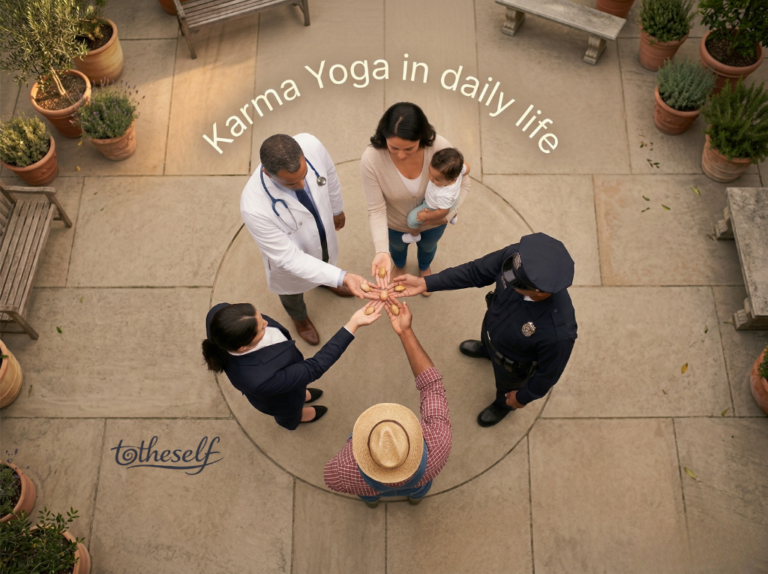
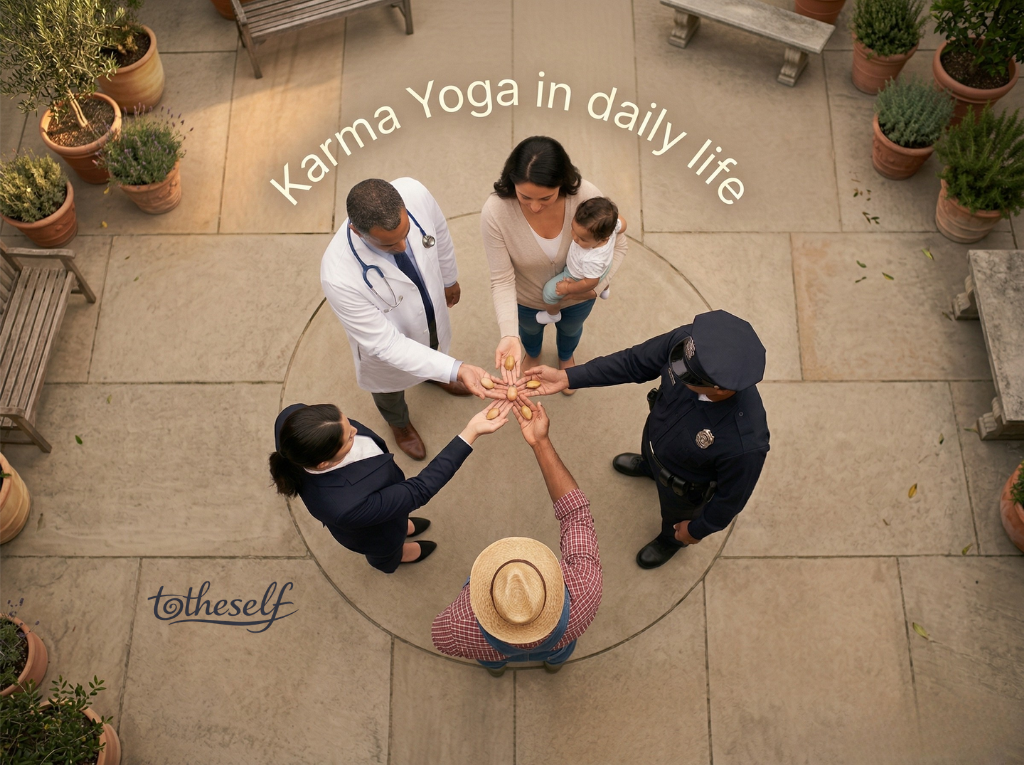
Here are daily examples: If you are a doctor, you give your best treatment to ill people, but their success is their destiny. If you are a police officer, you do not take bribes. And, if you have children, your duty is to care for them without expecting any service from them later.
Enjoying the Benefits of Yoga Everyday
It is important to purify the mind. Sage Patanjali gives a helpful method. First, you cultivate friendliness toward happy people. Next, we show compassion toward the unhappy. A sincere practitioner directs gladness toward the virtuous. Finally, keep indifference toward the wicked. By remembering this, your mind stays peaceful.
We cannot force anyone to fulfill their duty, but we can focus on fulfilling our own duty with a disinterested mind. A practitioner always gives but does not think about receiving, because receiving builds an obstacle. Everyone seeks happiness, eternal life, fearlessness, and freedom. We reach all of that when we get free from attachments. How can we act in society without desire? It seems difficult. However, it is even harder to fulfill all desires, because they are never satisfied. Therefore, it is easier to renounce them. Enjoy the benefits of yoga everyday. Even if you just apply a little of this to your life, it will help you to make your life better.